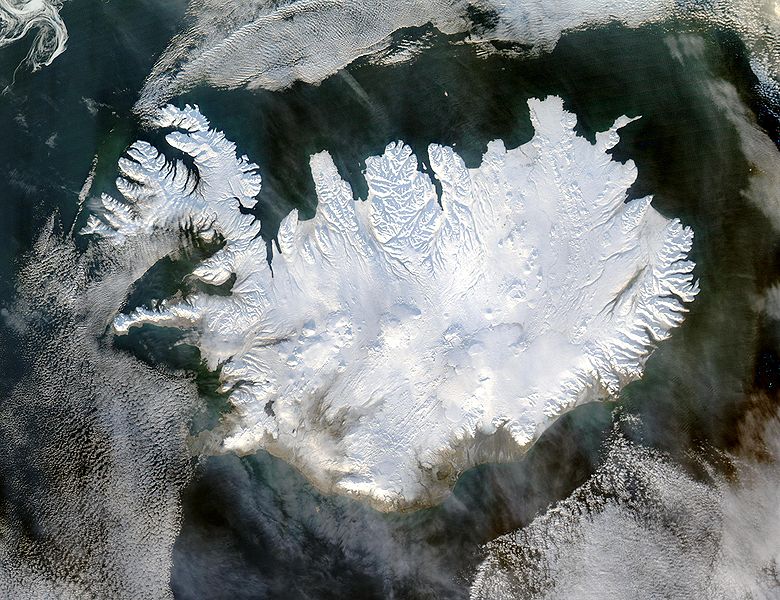
Iceland is a European island country located in the North Atlantic Ocean[6] on the Mid-Atlantic Ridge. It has a population of about 320,000 and a total area of 103,000 km2 (39,769 sq mi).[7] The capital and largest city is Reykjavík, with the surrounding areas in the southwestern region of the country being home to some two-thirds of the national population. Iceland is volcanically and geologically active. The interior mainly consists of a plateau characterised by sand fields, mountains and glaciers, while many glacial rivers flow to the sea through the lowlands. Iceland is warmed by the Gulf Stream and has a temperate climate despite a high latitude just outside the Arctic Circle.
According to Landnámabók, the settlement of Iceland began in AD 874 when the Norwegian chieftain Ingólfur Arnarson became the first permanent Norwegian settler on the island.[8][9] Others had visited the island earlier and stayed over winter. Over the following centuries, people of Norse and Gaelic origin settled in Iceland. From 1262 to 1918 it was part of the Norwegian, and later the Danish monarchies. Until the 20th century, the Icelandic population relied largely on fisheries and agriculture. In 1994, the nation became party to an agreement that established the European Economic Area, thus allowing it to diversify from fishing to economic and financial services. According to the Freedom of the Press (report), Iceland is the freest country in the world.
Iceland has a free market economy with relatively low taxes compared to other OECD countries,[10] while maintaining a Nordic welfare system providing universal health care and tertiary education for its citizens.[11] In recent years, Iceland has been one of the wealthiest and most developed nations in the world. In 2007, it was ranked as the most developed country in the world by the United Nations' Human Development Index, and the fourth most productive country per capita.[12] In 2008, the nation's banking system systematically failed, causing significant economic contraction and political unrest that led to early parliamentary elections making Jóhanna Sigurðardóttir the country's Prime Minister.[13]
Iceland is a developed and technologically advanced society. Icelandic culture is founded upon the nation's Norse heritage. Most Icelanders are descendants of Norse (particularly from Western Norway) and Gaelic settlers. Icelandic, a North Germanic language, is closely related to Faroese and some West Norwegian dialects. The country's cultural heritage includes traditional cuisine, poetry and the mediaeval Icelanders' sagas.
more on Iceland HERE!
